The Quiet Power of Journalling in Your 50’s
Creating space for clarity, calm, and a deeper connection to yourself
There’s something quite special about this stage of life.
By the time we reach our 50’s, we’ve lived through a lot—raising families, building homes, navigating challenges, celebrating milestones, and quietly carrying more than we often give ourselves credit for.
And somewhere along the way, we can forget to check in with ourselves.
That’s where journalling in your 50’s becomes so powerful.
Not as another thing to add to your to-do list, but as a gentle pause. A moment that belongs entirely to you.

Why journalling in your 50’s feels different
In your younger years, journalling can feel like a place to dream, plan, or process big emotions.
In your 50’s, it becomes something deeper.
It’s a place to:
- Reflect on where you’ve been
- Make sense of what you’ve learned
- Reconnect with what truly matters
- Create space for the next chapter
Journalling in your 50’s isn’t about having all the answers—it’s about understanding yourself a little more with each entry.
Make it feel like a moment just for you
One of the loveliest ways to begin (or return to) journalling is to make it feel special.
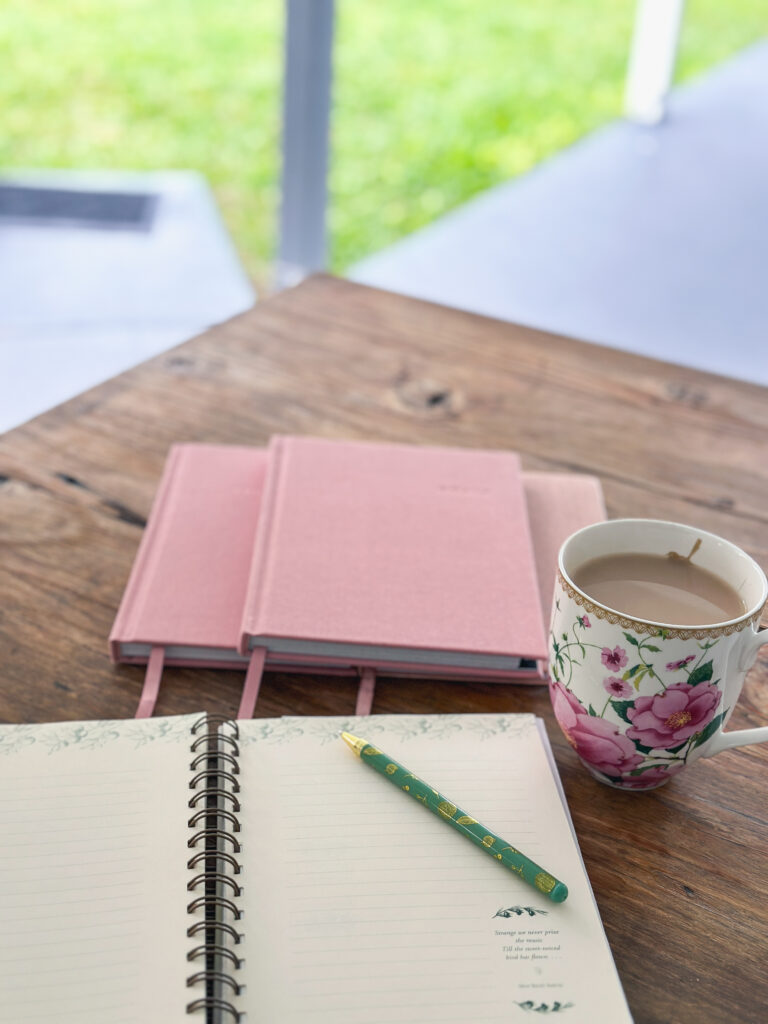
Choose a journal that you genuinely love. Not just something practical—but something that feels beautiful in your hands.
Pair it with a pen that writes effortlessly.
These small details matter. They turn journalling into something you look forward to.
It becomes a ritual.
A quiet little pocket of your day where everything slows down.
Create a calm, interruption-free journalling space
Journalling doesn’t need a lot—but it does need intention.
Find a space in your home where you can sit comfortably, even if it’s just a corner of the table with a cup of tea.
Somewhere you won’t be interrupted.
For me, it’s often outside with a warm drink, early in the morning before the day begins. On rainy days I have a space in our cabin
It’s not about perfection—it’s about creating a space where your thoughts can flow freely.
Schedule your journalling time (and make it non-negotiable)
If we wait until we “feel like it,” journalling often gets pushed aside.
Life is full, and there’s always something else to do.
Instead, diarise your journalling time—just like you would an appointment.
And treat it the same way.
Non-negotiable.
Whether it’s:
- 10 minutes in the morning
- A quiet afternoon reset
- Or a weekly journalling session on a Sunday night
This is how a journalling habit gently becomes part of your life.
Struggling to start? Use journal prompts
One of the biggest barriers to journalling is simply not knowing what to write.
And honestly, I’ve had those days too.
That’s where journal prompts can be incredibly helpful.
There are some beautiful guided journals and prompt packs available that gently lead you into your thoughts.
I was given a beautiful set by Emily and Mitch, and I reach for them often—especially on those days when my mind feels a little cluttered. I’ve linked them here if you’d like to take a look—they’re wonderful for getting started.
You can also choose prompts that suit where you are in life.
I’ve personally used:
- Health and Wellbeing journal prompts
- Creativity Cultivation journal prompts
Both have helped me in different ways and taken away that “where do I start?” feeling.
You don’t need to journal every day
There’s a common belief that journalling needs to be daily.
But it really doesn’t.
Journalling once a week can be just as powerful.
A Sunday night journalling session is a beautiful way to:
- Clear your mind
- Reflect on your week
- Set intentions for the week ahead
This simple habit can bring a sense of calm and clarity that carries into the days ahead.
The benefits of journalling in your 50’s
Over time, the benefits of journalling in your 50’s begin to show up quietly.
You may notice:
- Clearer thinking
- Reduced overwhelm
- Greater self-awareness
- A deeper sense of calm
- More aligned decision-making
And perhaps most importantly—you reconnect with yourself.
Not the version of you who is always doing, giving, and organising—but simply you.
This is something I’ve experienced deeply through my own journalling practice, especially when I focus on gratitude. If you’d like to explore that further, you can read more in my post on The Power of Gratitude and how a simple gratitude practice can shift your mindset.
A gentle invitation
If you’ve been thinking about starting a journalling practice, consider this your nudge.
It doesn’t need to be perfect.
It doesn’t need to be daily.
It just needs to begin.
Start with a beautiful journal, a quiet space, and a few honest words.
That’s more than enough.
Journalling has also played a big part in helping me create what I like to think of as a quieter, more meaningful life—something I share more about in The Quiet Luxury of a Meaningful Life: Finding Joy in What Truly Matters.